
Do you want to know some interesting native animals of Italy?
Italy houses a high presence of endemic species, with over 500 bird species, over 100 species of terrestrial mammals, and almost 200 insect species. Around 800 species of Italian animals in total!
Italy is, in fact, number one in faunal biodiversity in the continent, more than 1/3 of all European fauna.
11 Interesting Native Animals of Italy

Wanna know more about wild animals in Italy? Then you’ve come to the right place.Here’s our list of 11 animals native to Italy.
1. Italian wolf (Canis lupus italicus)

This animal played a role in the legend of founding of Rome by suckling the twins Romulus and Remus.
Also known as the Apennine wolf, the Italian wolf is held in high regard in Italian culture. It is, in fact, the national animal of Italy.
Italian wolves are a subspecies of the gray wolf native to the Italian peninsula and have been strictly protected since the 1970s.
Since the 1990s, the species’ range has expanded into Switzerland, as well as southwestern France. Now these wolves live mostly on the Apennine Mountains and the Western Alps.
2. Italian Aesculapian snake (Zamenis lineatus)
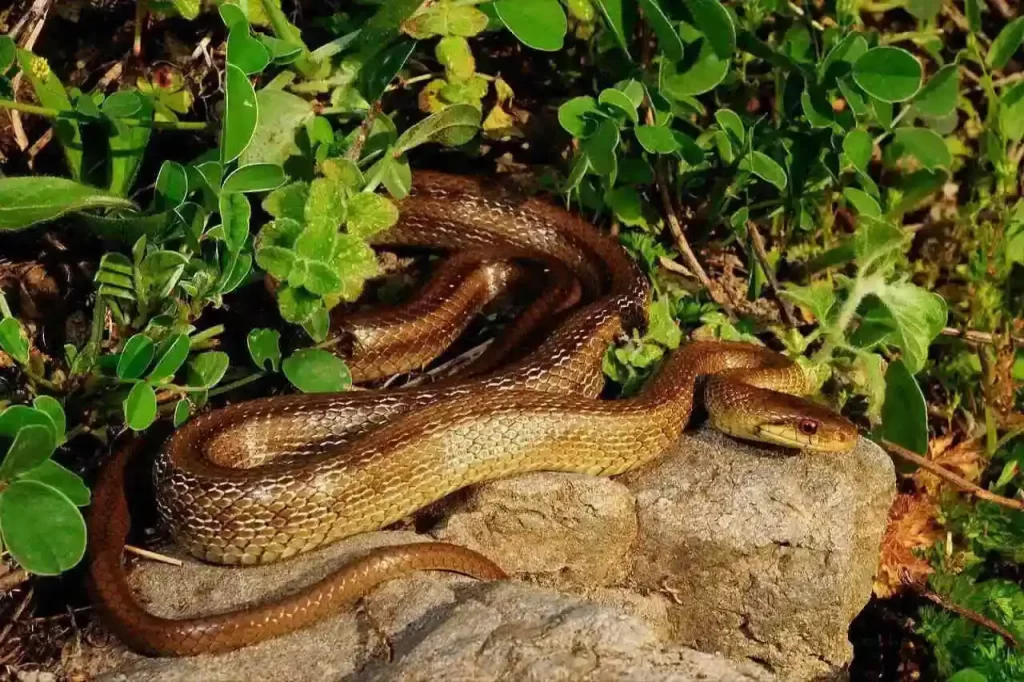
Italian Aesculapian snakes are non-venomous colubrids that are endemic to southern Italy, particularly Sicily.
The Italian Aesculapian snake is called saettone occhirossi in Italian, which means “red-eyed racer” because of the color of its iris.
These snakes have smooth scales that are typically bronzy in color with four dark brown stripes. They reach up to 2 meters in length.
Italian Aesculapian snakes feed on eggs, lizards, and small mammals.
3. Italian hare (Lepus corsicanus)

The Italian hare is brown with a cream-colored belly and is generally smaller than the European hare.
Also called the Corsican hare and the Apennine hare, this animal is common and widespread on the island of Sicily. It is also found on mainland Italy and ranges as far north to Tuscany and Foggia.
The Italian hare was introduced to Corsica somewhere between the 14th and 17th centuries. Only a few have been recorded there recently, however.
4. Sardinian long-eared bat (Plecotus sardus)

This species is a recent discovery. First identified in 2002 from the caves of central Sardinia, the Sardinian long-eared bat is small – weighs below 10 grams and grows up to about 1.5 to 1.8 inches.
This bat’s distinguishing feature is its oval-shaped ears. It is the single surviving endemic mammal on the Island of Sardinia.
5. Marsican brown bear (Ursus arctos marsicanus)

The Marsican brown bear takes it name from Marsica, Italy, where the animal has long had a significant presence.
The Marsican brown bear is relatively calm and not known to be aggressive towards humans.
Otherwise known as the Apennine brown bear and orso bruno marsicano in Italian, the Marsican brown bear is protected by the Italian government. The small, isolated population thrives in the Abruzzo, Lazio, and Molise National Park.
6. Apennine chamois (Rupicapra pyrenaica ornata)

Dubbed “the world’s most beautiful chamois,” the Apennine chamois can be found only in Italy.
These goat-like animals live in small numbers in the Abruzzo, Lazio and Molise National Park; Majella National Park; Sirente-Velino Regional Park; Gran Sasso and Monti della Laga National Park; and on the Sibillini Mountains.
The very little genetic variation due to long periods of genetic isolation poses a threat to the survival of this species.
Global warming and climatic changes are also said to shrink the size of these beautiful animals.
7. Italian cave salamander (Speleomantes italicus)

The Italian cave salamander, a lungless species of salamander, is native to northern Italy, particularly the northern and central Apennine Mountains. They are mostly found in caves as the name suggests, as well as underground waters and wooded valleys, and on rocky outcrops.
These Italian animals breathe through their moist skin, grow up to about 12 cm in length, and are dark brown-reddish in color.
8. Sardinian deer (Cervus elaphus corsicanus)
The Sardinian deer, also called Corsican red deer or simply Corsican deer, is smaller than the usual red deer, with shorter legs and a longer tail.
The Sardinian deer is native to the Italian island of Sardinia and the French island of Corsica in the Tyrrhenian Sea.
The species became extinct in Sardinia in the 1970s, but it was reintroduced and is now being bred on the island’s Monte Arcosu Forest.
9. Apennine yellow-bellied toad (Bombina pachypus)
The Apennine yellow-bellied toad can be found in ponds and ditches in the south of the Valley of the River Po, throughout the Apennine Hills and southern tip of mainland Italy.
This toad is characterized by a rounded snout, triangular pupils, and wart-covered skin on the back. It is mostly dark tan or dark greyish-brown in color and often with bright spots.
Like most species in this list, the Apennine yellow-bellied toad is threatened by habitat loss.
10. European owl moth (Acanthobrahmaea europaea)

The European owl moth lives among broad leaf woods in mountainous areas of southern Italy, where their predators are wild boars that eat both their host plants and their pupae in the ground.
The European owl moth is the only species in the genus Brahmaea in Europe. Most are found in eastern Asia. Like other members of the genus, the European owl moth can be identified by wing veins in adults and pupal dorsal spines on abdominal segments.
Adult European owl moths soar from late March to early May of the year. They are active after sunset and are said to be able to withstand the cold that some can also be seen flying during snowfall.
11. Calabrian black squirrel (Sciurus meridionalis)
The Calabrian black squirrels are arboreal animals that live in the forests of the southern Italian Peninsula, particularly in the regions of Calabria and Basilicata. Their nests are often found in pine or oak trees, mostly near black pine as the seeds are an important food source.
The Calabrian black squirrel is akin to the red squirrel in its behavior. It is larger than its red cousins and its coat color can vary – from dark brown to blackish.
The Calabrian black squirrel has a stable population. However, due to its small range, it likely qualifies for vulnerable or even near threatened.