
Bandiera d’Italia or the Italian flag, one of Italy’s most important and best-known symbols, is a vertical tricolor band, which is among the world’s most recognizable designs. The flag is known as the “Tricolore” because of this pattern.
The Italian “Tricolore” flag was first unveiled in June 1946, but it was officially accepted on 1 January 1948. The Italian Constitution mandates the flying of the country’s flag and displaying it in public areas.
The national flag of Italy is a source of national pride not just because of its colorful design, but also because of the rich history and symbolic significance it conveys.
Let’s get to know more about the “Tricolore,” its history and meaning, as well as other Italian flags.
History of the Italian Flag
Each of Italy’s republics over the centuries flew a separate flag before unification in 1861.
After the French Revolution began in 1789, Napoleon began conquering Italian states and transformed the face of Italy, establishing new republics and eradicating old ones. As a result of France’s appeal for national unity, many Italians organized political and military organizations to concentrate their efforts on building unity within their republics.

Photo by derivative work via Wikimedia Commons
The Transpadane Republic was an unofficial government in Milan that used the colors green, white, and red for its civic militia. Members of the militia wore the colors on their uniforms. Designed by Napoleon in Modena, the Cispadane Republic in 1797 had a tricolor horizontal stripe flag with a central symbol.
When the Cispadane Republic united with neighboring territories to form the new Cisalpine Republic, the stripes were rotated counterclockwise so that green was on one side and white and red were arranged vertically.
Though it looked like this at first, this wasn’t the final design for the Italian national flag. As a result of a short-lived region called the Italian Republic in the north of Italy, a geometric pattern was used for the flag.
The geometric design resembled those found on Napoleonic battle flags. During the reign of Napoleon, the Italian Republic was renamed the Kingdom of Italy, and the flag was redesigned to include a golden Napoleonic eagle in the center.
Photo by sodacan via Wikimedia Commons
As an unofficial symbol of Italian nationalism from 1798 to 1848. Italian history began anew once Napoleon’s reign ended in 1814. In 1848, Italy became a single country, and the Tricolore became a widely recognized symbol of the country’s national identity.
Flags that incorporated features of the Tricolore were commonplace in many areas, fostering a national identity. While fighting Austrian troops on 23 March 1848, soldiers of the Italian Confederation used the flag as a symbol of their unity. It was accepted by Sardinia the following month. A royal edict in 1861 designated it as the country’s national flag.
The shield, cross, and crown were added to the flag’s three stripes in 1861 when Italy became a monarchy under the rule of the House of Savoy. To represent the House of Savoy, there was a crown with a shield across.
When Italy became a republic in 1946, the flag returned to the Tricolore – a simple, vertical design. A final consideration was to have a flag that formally reflected the entire country, both geographically and historically.
Also read:
- Symbols of Rome: 10 Most Famous Ancient Roman Symbols
- Symbols of Italy: 13 Most Important Italian Emblems and Symbols
- 13 Most Popular Symbols of Good Luck in Italy
- Public Holidays in Italy
National Flag of Italy: Description and Meaning
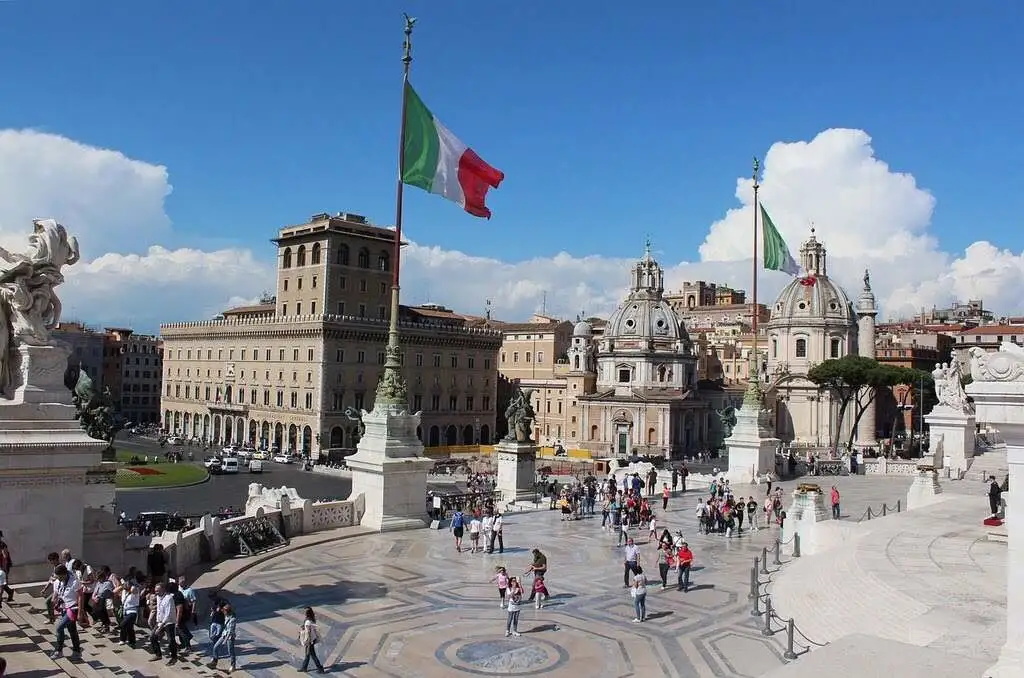
The proportions of the width and length of the Italian flag are 2:3. The “Tricolore,” as its name suggests, is composed of three distinct colors: green, white, and red. The flag features three equal-width stripes that run vertically from top to bottom.
The colors of the Italian flag’s symbolism aren’t defined by the law, therefore, its meaning is open to interpretation.
According to several religious traditions, the colors represent positive attributes. The color green is associated with hope, the color red is associated with charity, and the color white is associated with faith, according to this theological interpretation.
Based on the country’s geographic location and history, there is a second theory. White represents the snow-capped Alps, while green represents the lush vegetation that blankets the country’s plains, according to this interpretation. Red represents the bloodshed that occurred during Italy’s unification and independence war.
“Il Tricolore”

This Italian term – pronounced “Eel Tree-col-aw-ray” – refers to a flag of three colors.
Green, white, and red are the primary colors of the three vertical stripes that make up the Italian flag.
Be sure to distinguish the Italian flag from others like the Irish flag, which is longer and has a coat of arms on the white stripe; the flag of Mexico, which is also longer and has darker shades of red and green; and Côte d’Ivoire, which is orange, white, and green.
All of these flags have their colors reversed. Meanwhile, whenever the Italian flag is flown, the green stripes are placed closest to the pole.
What is the purpose of the Italian flag?

With its symbolism of national pride, the Italian flag serves as a reminder of the country’s rich history as well as its struggle to become a sovereign state.
Disrespecting the Italian flag is against the law, as it is in the Constitution of many other countries. Anyone caught tampering with or damaging an Italian flag can be fined up to 5,000 euros and/or go to prison.
It is common to see the Italian flag fluttering outside of government buildings and on special occasions such as national festivals and anniversaries.
Other Flags of Italy
The EU Flag

While in Italy, you’ll also see the European Union flag displayed in certain public spaces. This flag features a blue backdrop with 12 gold stars.
As part of Italy’s national anthem, the EU flag, which has twelve golden stars on a blue backdrop, must also be flown on public buildings and during official events.
However, in many cases, the two flags are flown at the same time as a symbol of Italy’s commitment to the European Union.
The Presidential Standard
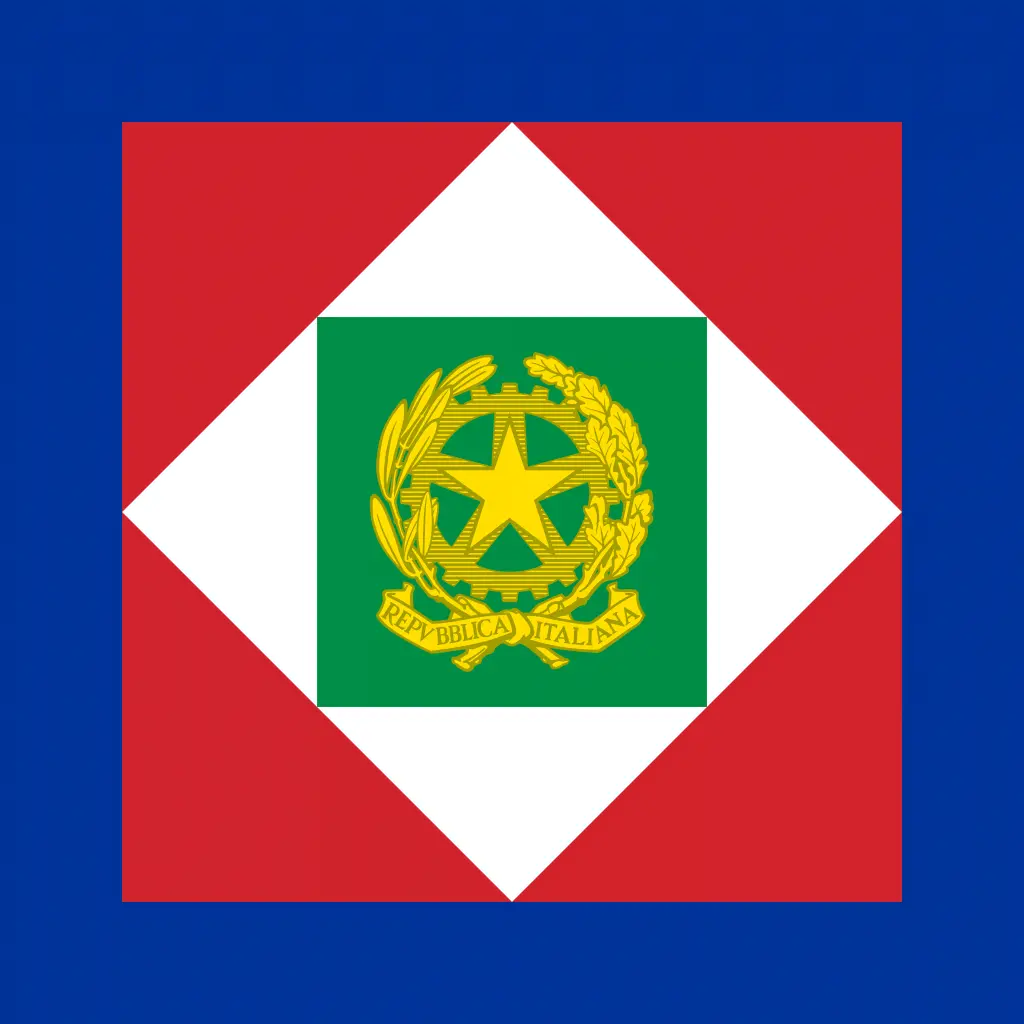
Italy’s President has a norm that he follows strictly. The current design is based on Napoleonic Italy’s square flag, with a blue field charged with the gold Italian emblem.
The President of Italy leads the Italian Air Force, the Carabinieri, the Italian Army, and the Italian Navy, all of which are depicted in the form of a square with a Savoy blue border.
The State Ensign

Photo by F l a n k e r via Wikimedia Commons
The Italian Republic’s emblem is displayed on the government ensign. It’s an Italian tricolor with the country’s emblem disfigured on top. Adopted on 24 October 2003, it has also been used as a naval flag on numerous occasions.
The Naval Ensign

Photo by F l a n k e r via Wikimedia Commons
In 1947, during World War II, the Italian Navy adopted its current flag.
The coat of arms of the Italian Navy depicts the insignia of the four Maritime Republics (Venice, Pisa, Genoa, and Amalfi) on the white center stripe, which is topped by the towered crown with rostra.
The Italian flag was not adopted by the Italian Navy because it would have looked identical to the Mexican ensign.
The Civil Ensign

Photo by Denelson83 via Wikimedia Commons
This is the Flag of Italy with a shield divided into four squares to represent the four Maritime Republics: Venice (top left), Genoa (top right), Amalfi (bottom left), and Pisa (bottom right), represented by their respective crosses.
Unlike the Italian Navy flag, the civil ensign does not have a sword-wielding lion or a crowned symbol, and the book of the Gospel is open.
The proportions of this flag are 2:3, which is a variation on the Italian Tricolore that was adopted on 9 November 1948, in Italy.
👏😮👏wow