
Are you ready to visit volcanoes in Italy?
If you’re planning a trip to Italy, you don’t have to worry about missing out on the country’s sights and attractions. There are plenty of things to do while visiting this beautiful place in Europe, but there’s nothing quite like seeing the power of nature at work!
Volcanoes have been erupting and creating land masses for millions of years — and in Italy, they are particularly more active. In fact, there are two super active volcanoes here: Etna and Stromboli. Both are located in Sicily but are also very different from one another.
Here are some details about the most visited volcanoes in Italy and how they can help you plan your trip accordingly.
Volcanoes in Italy
Here are 10 volcanoes in Italy that you can visit.
1. Monte Nuovo

Location: Pozzuoli, Metropolitan City of Naples, Italy
Monte Nuovo, which in English means “New Mountain,” is a cinder cone volcano located within the Campi Flegrei caldera in Southern Italy.
Campi Flegrei is a caldera located in the Gulf of Naples, which is the largest volcanic caldera in the world. The last eruption occurred around 40 BC, but there are still eruptions happening every few decades.
The name “Campi Flegrei” – or “Phlegraean Fields” in English – literally translates to “burning fields.” It got this name because of its lava flows that reach temperatures over 1,000 degrees Celsius (1,832 degrees Fahrenheit).
In the most recent portion of the Holocene which spanned from 29 September to 6 October 1538 when Monte Nuovo was formed, there was just one eruption. However, it was preceded by a string of earthquakes that caused significant damage and shifts in the elevation of the land.
2. Solfatara

Location: Pozzuoli, Metropolitan City of Naples, Campania, Italy
Campi Flegrei are best known for Solfatara which is notorious for its sulfurous smell. Solfatara is one of Europe’s most active volcanoes and the closest active one to Naples.
The main crater of the Solfatara has been dormant for over 4500 years, but another crater nearby has been active since 1749! This smaller cone-shaped crater emits steam and sulfurous gases, which form a misty cloud around its peak.
Its name “Solfatara” means “fumarole” or “smoking place,” or literally: “sulfur place.”
For Campi Flegrei tours and tickets, check out deals here.
3. Monte Amiata

Location: Abbadia San Salvatore, Province of Siena, Tuscany, Italy
Monte Amiata is an inactive volcano located in Tuscany, Italy. The mountain was formed by numerous eruptions over the last 2 million years, creating a large caldera (giant crater) on its eastern side.
Monte Amiata was active during the Pliocene period but has been inactive since the Holocene period. It has produced a rich variety of rocks spanning over 3 million years.
Monte Amiata is 1,738 meters high at its highest point and sits atop an ancient shield volcano known as Monte Vettore. It’s listed as an active volcano, although it hasn’t erupted for about 180,000 years.
Of course, there are no guarantees that Monte Amiata won’t erupt again anytime soon. However, if you plan to visit this mountain, then it is best to check for warnings before doing so.
If you want a hassle-free tour here, check out this deal.
4. Monte Vulture

Location: Vulture, Province of Potenza, Basilicata, Italy
A stratovolcano with a peak caldera and a few ectopic cones, the remote Monte Vulture has erupted 150 sq. km. of pyroclastic and lavas.
This extinct volcano is situated some 56 km. (35 mi.) north of the Southern Italian city of Potenza, in the most important wine zone in the Basilicata region. Here is where the DOC wine Aglianico del Vulture is cultivated.
If you’re interested in seeing this majestic peak firsthand, there are many different ways that you can visit Monte Vulture and enjoy its natural beauty while also learning more about its fascinating history and geology. The easiest way would be to join a guided tour of the area.
Check out this deal where you’ll be guided to the best view of the volcano.
5. Vulcano

Location: Vulcano, Aeolian Islands, Sicily, Italy
Vulcano is a volcanic island in the Aeolian Islands of Italy, situated between the islands of Lipari and Salina. It is a stratovolcano, which means it has multiple layers of lava on top of each other, like a layer cake.
The volcano doesn’t have a crater; instead, its summit is flat, so lava flows out onto land instead of falling into water or underground chambers (which would cause explosions). It is one of Italy’s four active volcanoes, along with Etna, Mount Stromboli, and Mount Vesuvius.
Some experts say that while Vulcano looks like it might be dangerous to visit, there aren’t many hazards here compared to other volcanoes around the world.
6. Vulcanello
Location: Vulcanello, Vulcano, Aeolian Islands, Sicily, Italy
Vulcanello is an active volcano in the Aeolian Islands, located specifically on the volcanic island of Vulcano. Vulcanello is a young cone that is the foreground of the more active Vulcano.
Vulcanello has erupted many times over the last few centuries and is considered to be one of Italy’s most active volcanoes.
Vulcanello is a popular tourist destination for people who love nature and hiking. There are also many accommodation options available for visitors, so you can enjoy your stay without having to worry about organizing anything yourself!
7. Mount Stromboli

Location: Stromboli, Aeolian Islands, Sicily, Italy
Mount Stromboli has erupted various times and is active with frequent minor eruptions. This volcano is seen from many points on the Aeolian Islands in the Tyrrhenian Sea, off the north coast of Sicily. This earned the island of Stromboli its moniker: “Lighthouse of the Mediterranean.”
Stromboli Island is the location of one of the world’s most active volcanoes. It is one of several islands that make up the Aeolian Islands (Aeolian Islands).
Mount Stromboli was formed by a series of volcanic eruptions from about 700,000 years ago to 370,000 years ago. In this volcanic arc, active volcanism has been ongoing for at least 2 million years.
The volcano has been in almost continuous eruption since at least 50 BCE; this makes it one of the longest-active volcanoes on earth.
8. Mount Vesuvius
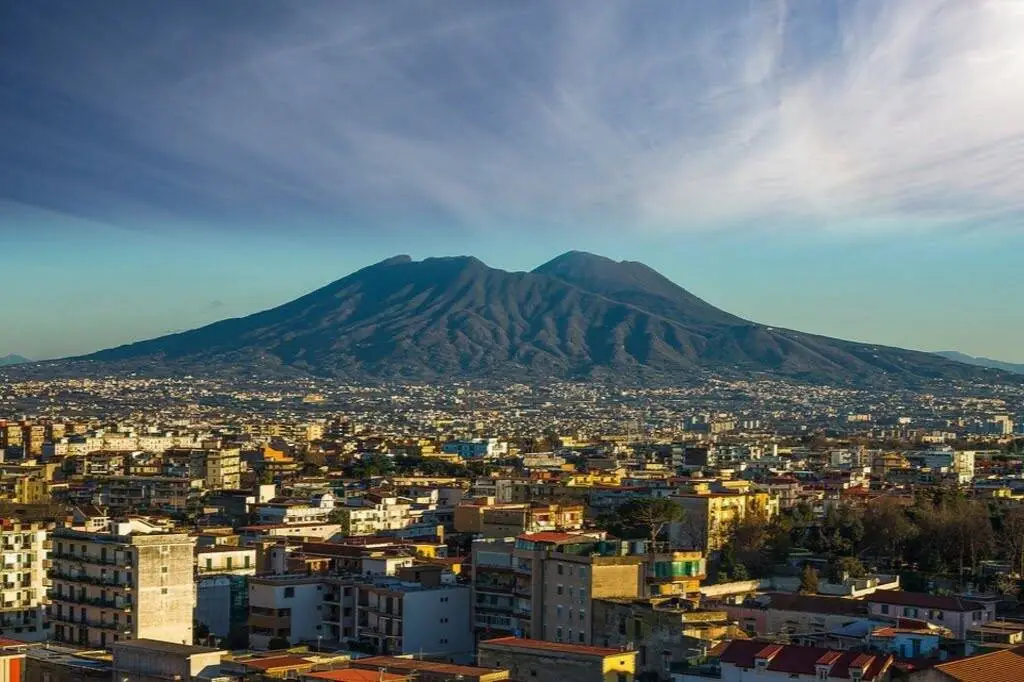
Location: Vesuvius National Park, Ottaviano, Metropolitan City of Naples, Italy
Vesuvius National Park is a protected area in Campania and Lazio, Italy. It is right on the slopes of Mount Vesuvius and includes the volcano itself and its surrounding area.
The park was established in 1995 after Mount Vesuvius erupted in October 1991. A large part of the area was closed off to tourists as it contained several buildings that were damaged by lava or ash flows during that eruption.
In 1992 all of these buildings were demolished except for Pompeii’s Amphitheatre (ancient Roman gladiatorial arena) and Herculaneum’s House of Caecilius Jucundus and House of the Skeletons (both old Roman villas).
9. Mount Etna

Location: Adrano, Metropolitan City of Catania, Italy
Mount Etna, also called Mongibello, is the tallest active volcano in the European region and the most active in Italy, which makes it a prime location for volcanology enthusiasts to visit.
Being one of the most active volcanoes worldwide, Mount Etna – or simply Etna – has been constantly erupting for over 2,700 years (and counting), which makes it also the world’s most monitored.
The lava flows from Mount Etna can reach heights up to 500 meters tall. Still, if you’re feeling lazy, there are plenty of viewing platforms at various points along its slopes where you can get up close and personal with some flowing hot magma.
Etna sits on Sicily’s east coast, which means that if you go during the summer months (June through September), chances are that you’ll be able to watch as pyroclastic flows cool off into steamy clouds before dissipating into nothingness.
You might even feel like you’re standing right next to Mount Stromboli when looking down onto its crater since it’s located just offshore from Mount Etna on nearby Aeolian Islands!
10. Monte Busca

Location: Villaggio Monte Busca, Tredozio, Province of Forlì-Cesena, Emilia-Romagna, Italy
In the Tuscan-Romagnolo Apennines, the so-called fake volcano Monte Busca rises between Val Montone and Val Tramazzo. This tiny mount is distinguished by the existence of a perpetual flame that has been burning since before 1500 and is incorrectly referred to as a “volcano.”
This is Italy’s “tiniest volcano,” which is a blazing fountain. Gaseous hydrocarbons that emit continuous flames when they come into touch with oxygen are to blame for the ever-burning flame. A particular suggestion is made by the flames that appear from the subsurface in the midst of an uncultivated field.
Monte Busca is located in an amazing place in the wilderness with lovely views. It’s very peaceful and easy to find, a relaxing place to camp with friends. Bring some food and a tent!
Here’s a mindblowing fact about Monte Busca: Its fire has been burning for thousands of years! This is possible due to an everlasting source of methane gas underground.