
Are you interested in knowing the different common birds in Italy? Read along because we have the list for you!
In Italy, bird populations fill up the sky. Because of the country’s vast environment, it has been home to these lovely flying and unique singing creatures. With more than 500 species, there are the most common and the rarest, endemic, and endangered, big or small.
As much as we want to list them all, we choose to narrow it down to the common birds for now. Those birds that you might have seen or heard singing early in the morning and all day long are beautiful.
So, come on! Together, let’s be amazed by the common Italian birds in town!
FUN FACT: Bird is called l’uccello (loo-chell-loh) in Italian. The plural term is “gli uccelli” (lly oo-chell-leeh).
13 Common Birds in Italy
Here are 13 of the most common birds in Italy.
1. Italian sparrow (Passer italae)

Before all the other common birds in Italy, let’s put the national bird on top – the Italian sparrow.
You must have seen this small brown bird with a gray to white chest as you walk through famous places in Rome or simple suburban areas of Northern to Central Italy. However, it is mostly found near human habitation. The difference between a male and a female Italian sparrow depends on the color and length of their plumage.
The Italian sparrow, although common, is considered vulnerable because its numbers have been decreasing in recent years. This may be due to food shortage. These social birds feed on seeds and insects.
INTERESTING FACT: Did you know that Italian sparrows are among the many wild birds that are most eaten in Italy?
2. European goldfinch (Carduelis carduelis)
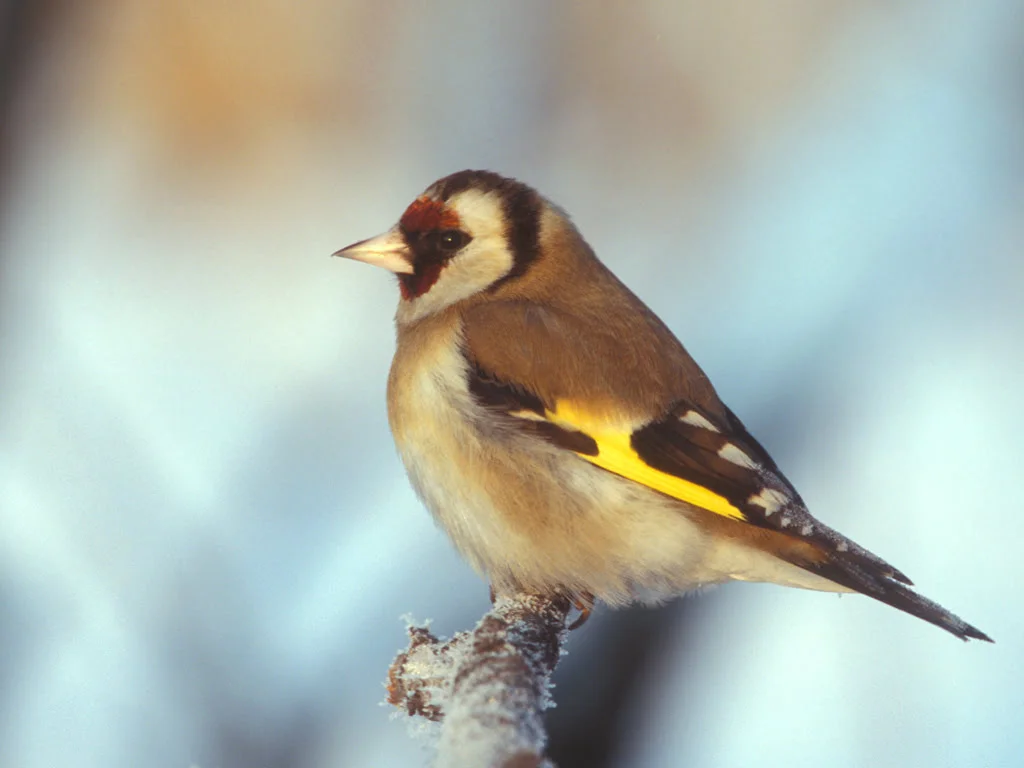
If there were to be another famous Italian common bird aside from the Italian sparrow, it should be the European goldfinch. This passerine bird has been a part of many famous Italian Renaissance paintings, such as the Madonna and Child.
European goldfinch can be distinguished by its face as it has a red mask. Males have a darker and bigger red face than the female, with black shoulder feathers, while the female has brown. Both have black and white striped wings and a yellow bar.
They love small seeds, so if ever you want to have some European goldfinch in your backyard, plant some cornflower and teasels. Many people keep these birds as pets, too.
INTERESTING FACT: The European goldfinch is a bird that people like to keep in cages. Sadly, it is sometimes taken and sold illegally in various countries.
3. Common wood pigeon (Columba palumbus)

Pigeons must be everywhere, especially in Italy, but the population of the common wood pigeon is the largest. They are often sighted in flocks in places they consider as habitat, from the rooftops of buildings to the ground, and even where there are a lot of trees. Whether in a highly urbanized area or a rural one, flocks of common wood pigeons are found in many parks and gardens.
Common wood pigeons come in grayish and soft blue colored feathers and a pinkish chest. As they become adults, notable green and white patches appear around the neck. Pigeons generally have a stout body, short neck, and slender bills.
For food, common wood pigeons eat vegetables, seedlings, grains, fruits, small worms, and even ants. And because it seems that these birds highly depend on crops for their food, they are considered agricultural pests.
FUN FACT: It is so easy to learn the call of a common wood pigeon! Just speak the cooing words: coo-COO-COO-coo-coo.
4. Eurasian collared dove (Streptopelia decaocto)

The Eurasian collared dove comes from the Columbidae family, which also includes the common wood pigeon. This dove has spread all over the world because they breed rapidly and are considered colonizers.
The Eurasian collared dove is a medium-sized dove that can be recognized by its black and white half-collar found on the neck. They have a square tail and are smaller than a wood pigeon. Their colors are either pinkish-gray or gray buff in general, with red legs and a black bill.
They feed on grains, seeds, or livestock feeds. Where there are farms, spilled grains, or even households, flocks of Eurasian collared doves, as recorded in numbers of 10, 50, or even 10,000, can come after their food.
GOOD TO KNOW: Wanna sing a Eurasian collared dove song? Just say, “goo-GOO-goo.”
5. Eurasian chaffinch (Fringilla coelebs)

In places where there are a vast number of trees, whether in forests or parks, you can find another common passerine bird, the Eurasian chaffinch. They love to eat fallen seeds on the ground or wait for you to feed them when they see you in parks. It is only during the breeding season that they choose to eat their favorite defoliating caterpillars.
Both male and female Eurasian chaffinches exhibit white stripes on their wings. While the female has duller shades of grey and brown back feathers, with paler ones on the lower. The distinguishing mark of the male would be the gray-crown and its rusty red overall color, with black wings. When the female first breeds at 1 year old, she solely makes the nest in bushes or branches of trees.
According to William Thorpe, for the Eurasian chaffinch juvenile to learn how to sing properly, it must be exposed to adult male’s song during its maturation stage after it has hatched.
6. Dunnock (Prunella modularis)

Dunnocks are passerine birds, or perching birds, that are as small as robins. They can be found hopping around looking for something to eat. These birds consume a variety of food, including small insects, seeds, spiders, and tiny worms.
Their nesting places would be on hedgerows, gardens, and woodlands. This is why they are also called “hedge sparrows,” although they are not actually sparrows.
Dunnocks have mainly brown and gray feathers with black patches on their back and facial area. They have slim, pointed beaks and legs with a blend of orange and gray colors. They make a chatty sound, like a quick and squeaky song that goes on without stopping or slowing down.
FUN FACT: Did you know that dunnocks are one of the very few birds that are polyandrous? It means the female breeds with two or more males, which is something that’s truly uncommon when it comes to birds!
7. Common blackbird (Turdus merula)

Common blackbird is a species of medium-sized insectivorous or omnivorous bird that can be easily identified in Italy. Blackbirds love various kinds of insects, earthworms, berries, and fruits. That’s why they love to stay in gardens, orchards of fruit-bearing trees, farms, and woodlands.
The adult male blackbird has glossy black feathers with a yellow eye-ring. While juvenile and adult females have dark brown feathers with a soft brown bill. They breed in the spring and are very territorial.
Common blackbirds species are widespread and unthreatened despite decrease in numbers because of changes in agricultural practices.
FUN FACT: If you ever hear a singing blackbird at dawn, it’s the male that starts courting a female!
8. Mallard (Anas platyrhynchos)

Mallards are indigenous wild ducks frequently found in Italy’s wetlands, including both naturally occurring and artificially constructed ponds and marshes. They are from the family Anatidae.
Male mallards have green heads while females have brown-speckled layers of feathers, but both have a blue or purple patch with white underneath their wings.
They are considered gregarious and can eat water plants and small animals with other flocks, either big or small. While male ducks just make raspy calls, all the noise and quacking from mallards comes from the females.
FUN FACT: Mallards are waterfowl birds that feed on the surface rather than diving, so they are also called dabbling ducks.
9. Common shelduck (Tadorna tadorna)

If you come near lakes, mudflats, rivers, and coastlines in Italy during molting season, you can see not only hundreds but even thousands of common shelducks.
Common shelducks are waterfowl that look like geese but only have smaller and shorter necks. In their natural habitat, these ducks might utilize pre-existing holes and burrows made by other animals for nest-building purposes.
Although both male and female shelducks almost have the same white body with black and cinnamon patches, dark green head and reddish-pink bills, male common shelducks are notable for their large knob that extends up to the forehead. Female shelducks tend to be smaller in size.
FUN FACT: Once you hear a loud honk, it’s probably the common shelduck call!
10. Gadwall (Mareca strepera)

Gadwall is a duck that is a bit smaller than a mallard. It has a slim body, a white patch on its wings, and a whitish belly. In Italy, they can be easy to miss because male gadwalls don’t have blue, green, or white patches like other ducks. To spot a gadwall, look for its soft brown and gray feathers with detailed patterns.
Gadwalls are ducks that eat plants and stay near the edges of marshes and wetlands, lakes, ponds, and other bodies of water. They are known to swim to deeper areas and steal plants from other waterbirds.
FUN FACTS: When near a body of water, the sound resembling a burp may indicate the presence of a male gadwall. These birds emit short and reedy calls that resemble such sounds. Interestingly, their scientific name “strepera” translates to “noisy.”
11. Common magpie (Pica pica)

The common magpie, also referred to as the Eurasian or European magpie, is a member of the crow family known as corvids and belongs to the Holarctic radiation of “monochrome” magpies. It stands out as the only representative of its species in Europe, except for the Iberian Peninsula.
This magpie is black with green and violet sheen, white belly and shoulder feathers. Males and females look similar, but females are smaller. The young have a pink malar region, clear eyes, and shorter tails.
Common magpies mostly eat bugs that live in the grass, including worms, beetles, caterpillars, leatherjackets, and spiders. They also eat grains, fruits, and berries, as well as leftovers from people’s homes – such scraps and pet food – that they find on bird tables or near where chickens are kept.
FUN FACT: Many people think the common magpie is really smart and consider it one of the cleverest birds. Some even say it’s one of the cleverest creatures besides humans.
12. Long-tailed tit (Aegithalos caudatus)

_on_a_twig.jpg)
The long-tailed tit is known as a small, round tit with a short, stubby beak and a really long, skinny tail. The males and females look alike, and young birds shed their feathers to grow adult feathers before their first winter. Their feathers are mostly black and white, with some gray and pink mixed in.
They create small groups of 6 to 17 birds, which consist of families (parents and their young) from the last breeding season. When in such groups, they keep making regular calls and are usually heard before they’re seen. The calls get quicker and louder when the birds cross open areas or if one gets separated from its flock.
Long-tailed tits mostly eat bugs, especially the eggs and larvae of butterflies and moths.
INTERESTING FACT: The nesting sites of long-tailed tits are often attacked by predators, resulting in only about 17% of the eggs successfully hatching.
13. European robin (Erithacus rubecula)

If you ever see a bird with a bright orange face that is fascinating to watch and charming to catch in your backyard or garden, it’s the European robin. Both sexes bear the same orange color from face to breast, and a brownish back with a white belly.
These passerine birds just love to eat insects, especially worms, and also seeds and fruits. They are very territorial and will attack male invaders and competitors. During breeding, European robins can make their nest in scrap materials or even manmade boxes as long as there are leaves, grasses, and some feathers.
FUN FACTS: Robins are considered a gardener’s friend. And if ever you’ve received a Christmas card with a bird, it’s likely the famous robin!
RELATED POSTS: