
Interested to know the most common snakes in Italy? We have a list ready for you!
While some individuals harbor a fascination for these slithering creatures and even keep them as pets, others are gripped by an intense fear. In Italy, attitudes toward snakes are mixed. Are you aware that there is a unique and time-honored Festival of the Snake Catchers in the country?
In Cocullo, Abruzzo, the Festival of the Snake Catchers (Italian: Festa dei Serpari) is celebrated every year on May 1st in honor of Saint Dominic. During this festival, individuals or groups capture snakes that are later draped around the saint’s statue and carried throughout the town in a parade. Only those who have experienced this unique celebration can truly describe its essence.
As you explore one of Italy’s most unusual festivals, you may wonder about the snakes captured and paraded during this event – what they are and whether they are non-venomous or deadly. You’ll find out here!
Let’s begin discovering the most prevalent snake species found in Italy.
- Also read: 11 Interesting Native Animals of Italy
11 Most Common Snake Species in Italy
Listed below are some of the most common snake species in Italy.
1. Common grass snake (Natrix natrix)

The most common snakes you can find in Italy are the common grass snakes, which can be easily spotted near water sources such as ponds.
These snakes exhibit a range of colors from green to brown and possess a distinctive yellow or whitish hue at the back of their heads. Their diet consists mainly of fish and amphibians like toads and frogs.
As these reptiles lack venomous fangs, they employ various defense mechanisms including emitting a garlic-like odor, playing dead, and hissing and striking with their mouths shut.
The common grass snakes have significant populations inhabiting the southern regions of Italy.
2. Barred grass snake (Natrix helvetica)

Barred grass snakes are a common species in Italy, typically found in villages adjacent to bodies of water such as streams and ponds. They feed primarily on fellow reptiles, toads, and frogs. They deposit their eggs in biodegradable materials.
While non-venomous, it is still imperative not to provoke or handle these creatures unnecessarily as they can pose a risk if agitated due to their defensive behavior. When feeling threatened or provoked, barred grass snakes may become aggressive and bite.
The barred grass snake can be identified by its dark-green grayish hue with black bar lines running along the length of its body. These snakes can grow up to over 1 meter long with females tending to be longer than males.
Interestingly, prior to 2017, barred grass snakes were classified under the common grass snake Natrix natrix. However, they have since been given their own scientific name – Natrix helvetica.
3. Green whip snake (Hierophis viridiflavus)

The green whip snake, known for its rapid movement, is a prevalent species in Italy. This snake’s adaptability to various environments makes them ubiquitous not only in coastal areas but also in urban or rural zones such as gardens and shrubby regions.
Green whip snakes are opportunistic feeders and will consume anything from eggs to small birds, frogs, lizards, and even small mammals.
Similar to grass snakes, the green whip snakes are non-venomous but can be challenging to capture due to their agility. If cornered, they will fiercely defend themselves. The average length of this species can reach up to around 5 feet, with coloration varying between green and yellow hues accented by black stripes.
These are the snakes captured and paraded during La Festa dei Serpari, or the Festival of Snake Catchers. They are released back in the wild after the event.
4. Balkan whip snake (Hierophis gemonensis)

The Balkan whip snake is common in the Balkan areas and the extreme northeast of Italy. This slender snake is usually around 4 feet long and has a well-defined greenish-brown body and projecting round pupils.
Balkan whip snakes mainly stay on the ground, but they can also be found at heights up to 1,400 meters. They live in ruins, road banks, and mostly stony areas.
The snake is harmless to humans due to its lack of venom. When it feels threatened, it may bite forcefully, but the bite is not very harmful. During the day, it stays active and enjoys sunbathing. Its diet primarily includes small mammals, reptiles, certain insects, and birds.
5. Asp viper (Vipera aspis)

The only known common venomous snake in Italy is the asp viper, also referred to as European asp or aspic viper among others. This species can mainly be found in sunny, low-lying fields with meadows, scrublands, wood clearings, or even waste dumps, but it is especially common in limestone areas.
Asp vipers have a distinct broad and triangular neck-to-head shape. They can grow as long as nearly 3 feet, with males noticeably slimmer than females. They eat mostly carnivorous prey like lizards and small birds, except for some kinds of mice.
Once bitten by an asp viper snake, the fatality rate is high, and it accounts for 90% of snake bites in Italy.
6. European ratsnake (Zamenis situla)

European ratsnakes are also known as leopard snakes because of their skin color, which can be a mixture of black, red, brown, yellow, gray, or black-and-white. They can come in either gray or tan with stripes or patches of red to brown with borders of black. They have scales with a ridge down the center, slim bodies, and wedge-shaped heads. Their pupils are round, just like most nonvenomous snakes.
These snakes can be found in shrubby vegetations, plantations, hilly coastal areas, rural gardens, and even in manmade areas such as parks.
European ratsnakes can grow up to 2 feet and 3 inches in length. They eat small lizards to rodents depending on age. Considered generally calm, they do not bite unless necessary. Don’t worry, though, because these snakes are not venomous.
7. Dice snake (Natrix tessellata)

Dice snakes, also known as water snakes, are common in Italy. This snake is notable for its dice-like belly design – yellow or orange with dark spots – where its name was derived from. Its body color varies from grayish green to almost black with black spots on the back.
Since dice snakes’ habitat is obviously underwater, especially in almost stagnant rivers, lakes, and streams, they are fish-eating snakes, but they also eat frogs and toads.
As for the size, males tend to be smaller than females, both ranging from 3.25 feet to 4.5 feet in length. Dice snakes are considered great swimmers and non-venomous.
8. Viperine snake (Natrix maura)

The viperine snakes are common in the northwestern part of Italy. The name is given because of their behavioral and aesthetic resemblances to other adder species in the same area. They are also called the viperine water snake. These snakes are considered semi-aquatic and live near ponds, rivers, or even brackish waters. They feed on fish.
Although its name is close to the venomous snakes called vipers, viperine snakes are actually non-venomous. Their color and behavior are associated with adder vipers but not their venomous bite. Their color ranges from gray to reddish brown and they can grow up to 3 to 4 feet in length.
9. Italian Aesculapian snake (Zamenis lineatus)
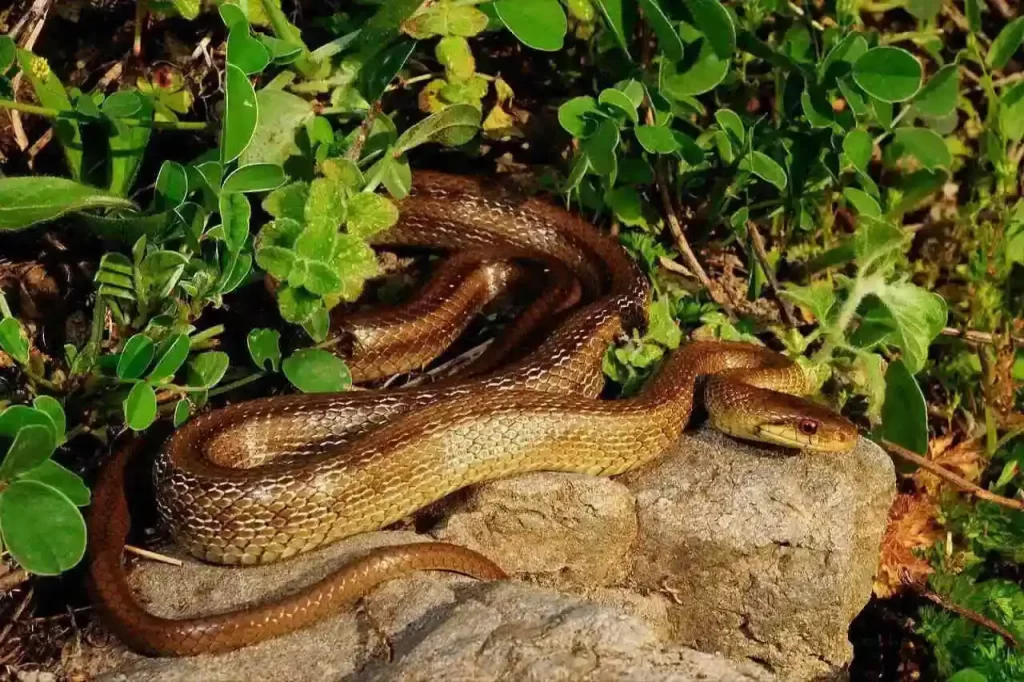
Although specifically found in Southern Italy and Sicily, Italian Aesculapian snakes are the best tree climbers.
This snake’s color is yellow to brown with four longitudinal stripes. It has a notable red iris, which is where the name red-eyed racer comes from. It can grow up to a maximum of 7.38 feet in length.
These common Italian snakes live in temperate areas with forests, scrublands, rural gardens, and even urban areas. They eat lizards, small mammals, and eggs, which are a favorite of snakes.
10. Aesculapian snake (Zamenis longissimus)

While Italian Aesculapian snakes are found in the southern part of Italy, the Aesculapian snakes thrive in the northern part. These snakes can grow for as long as 2 meters and love to inhabit forests with moist areas. They feed on rodents, shrews, moles, birds, and eggs.
The skin of the Aesculapian snakes is smooth, which gives a metallic sheen to their bronze color. They are most active during the daytime and can be found in the presence of humans, as they love to be in gardens or sheds as well. They are also good climbers of trees and trunks, so watch out for snakes falling when in the forests of Northern Italy.
11. Four-lined snake (Elaphe quatuorlineata)

Because of its black four-line stripes on the dorsal side, this common Italian snake is called a four-lined snake. The habitat of this yellowish-brown colored snake includes vegetation, forest margins, stonewalls, and even ruined buildings.
The four-lined snakes eat small animals like rabbits, rats, squirrels, and birds. They also feed on small lizards. When they are fully grown, they can be almost 6 feet long and up to 6 feet and 7 inches in rare cases, making them one of the biggest snake species in Italy.
While four-lined snakes are common in Italy, they are considered endangered in Bulgaria because of agriculture. They are non-venomous and are normally calm, which makes them easy to handle.