
Are you curious about the world’s smallest army? We have listed 17 amazing facts about the Swiss Guards you should know.
The Pontifical Swiss Guards have a storied history of service to the Vatican. They are the last remaining mercenary troops of Switzerland. Working alongside the Vatican’s Corps of Gendarmes, their Italian counterparts, these colorful Swiss soldiers are the Vatican’s private defense force responsible for guarding the Pope and his residence (the Apostolic Palace) and all official entrances to Vatican City in Rome, Italy.
The Swiss Guard comprises around 135 soldiers. These highly skilled guards, dressed in their iconic yellow, red, and blue uniforms, form the world’s smallest army. Despite their small numbers, they play a crucial role in ensuring the safety and ceremonial duties of the Vatican.
Read on to learn more amazing facts about the Swiss Guards.
17 Amazing Facts About the Swiss Guards

Tourists and pilgrims who flock to Rome often wonder: Who are the Swiss Guards, really?
Let’s delve into 15 fascinating facts about these guardians of the Holy See.
1. The Swiss Guard is the oldest military unit around
The rich history of the Swiss Guards dates back to 1506, making them one of the oldest military units in continuous operation.
The Swiss Guard was founded by Pope Julius II, who was so impressed by their courage and loyalty in the Italian Wars that he wanted to hire Swiss mercenaries for his protection.
The Swiss Guards continue their centuries-old tradition of service and loyalty within Vatican City — a testament to their unwavering commitment to safeguarding the Pope and his residence.
2. They are also called Halberdiers

The Swiss Guards, also known as the Pontifical Swiss Guards, are often referred to as Halberdiers because they wield a traditional weapon called a halberd, which is a combination of a spear and an axe.
The halberd was a popular weapon used by Swiss mercenaries during the 14th and 15th centuries, known for their exceptional skills and bravery in combat.
Even today, the Swiss Guards continue to carry the halberd as a symbol of their rich heritage and important duty.
3. The Swiss Guard’s motto means “Fiercely and Faithfully”
The motto of the Swiss Guard, “Acriter et Fideliter,” encapsulates their core principles and values. It highlights their fierce determination and unwavering faithfulness in fulfilling their responsibilities as protectors of the Vatican and the spiritual leader of the Catholic Church.
In Latin, “Acriter” translates to “Fiercely,” signifying the determination, courage, and unwavering commitment with which the Swiss Guard approaches their duty. On the other hand, “Fideliter” translates to “Faithfully,” emphasizing the deep sense of loyalty and trust that the Swiss Guard upholds.
4. They have four patron saints
The Swiss Guards have four patron saints: Ignatius of Loyola, Martin of Tours, Saint Sebastian, and Nicholas of Flüe.
These patron saints provide these soldiers with spiritual guidance and inspiration, reinforcing the importance of faith, compassion, bravery, and diplomacy in their service to the Vatican and the Pope.
READ ALSO: Most Famous Italian Saints You Should Know
5. The Swiss Guard’s uniform was inspired by Michelangelo

The Swiss Guard has an iconic distinctive uniform that consists of blue, red, orange, and yellow colors. The design was inspired by the Renaissance painter Michelangelo, who painted the famous Sistine Chapel.
6. This uniform has 154 pieces and takes 32 hours to make
This colorful gala uniform was introduced only after 1910. Each is meticulously tailored inside the Vatican barracks to fit each guard perfectly. This delightful creation consists of 154 individual pieces and demands a total of 32 hours to make.
7. The Swiss Guard has strict admission requirements
Before donning the iconic uniform, aspiring Swiss guards must meet stringent criteria:
- They must be single males of Swiss citizenship, standing at least 5’ 8″ or 174 cm tall
- The age range is from 19 to 30 years old
- They must possess a high school degree or professional diploma
- They must be endorsed as faithful Roman Catholics by their hometown’s parish priest
8. They are trained in Switzerland and then in Rome
All recruits are required to complete their basic military training in Switzerland. Swiss Guards should successfully finish this before proceeding to the initial five weeks of training with the guards in Rome.
9. The Swiss Guard’s annual ceremony takes place on May 6th
Every year on May 6th, the Swiss Guard holds a solemn oath ceremony. This special event commemorates the brave actions of the guards on that fateful day in 1527, known as the Sack of Rome. During this tragic event, 147 Swiss Guards valiantly defended Pope Clement VII from the troops of Emperor Charles V.
Regrettably, only 42 guards survived, but they managed to escort the Pope to safety.
10. They receive a personal blessing from the Pope
After taking their oath, the Swiss Guards and their parents have the special privilege of a private audience with the Pope. It’s a significant moment where they receive a personal blessing from His Holiness.
11. The Pontifical Swiss Guards are armed with both traditional and modern weapons
The Swiss Guards balance tradition and modern security measures to protect the Pope and Vatican City. They undergo rigorous training in unarmed combat and small arms.
These well-trained guards are equipped with a mix of traditional and modern weaponry. They use halberds, swords, and daggers for ceremonial purposes, but they also have pistols, rifles, and submachine guns for security.
12. When in their ceremonial dress, Swiss Guards carry pikes and wield swords

The pikes are long spears with pointed metal heads. Swiss Guards also wield swords when in their iconic ceremonial dress. While they’re marching, they proudly carry two swords with flaming blades.
13. Some of their armor comes from centuries past

Today, some of the armor in use actually harkens back to the 15th century! To keep things up-to-date, skilled blacksmiths create new armor to replace pieces that have seen better days.
Most of the Swiss Guard’s armor is about a century old, and back then, people tended to be smaller in stature. As a result, it doesn’t quite fit the bulkier guards of today.
In 2013, the Vatican teamed up with the Schmiede Schmidberger company to produce 80 brand-new armor sets. This project spanned around seven years.
14. Their helmet holds historical and symbolic significance
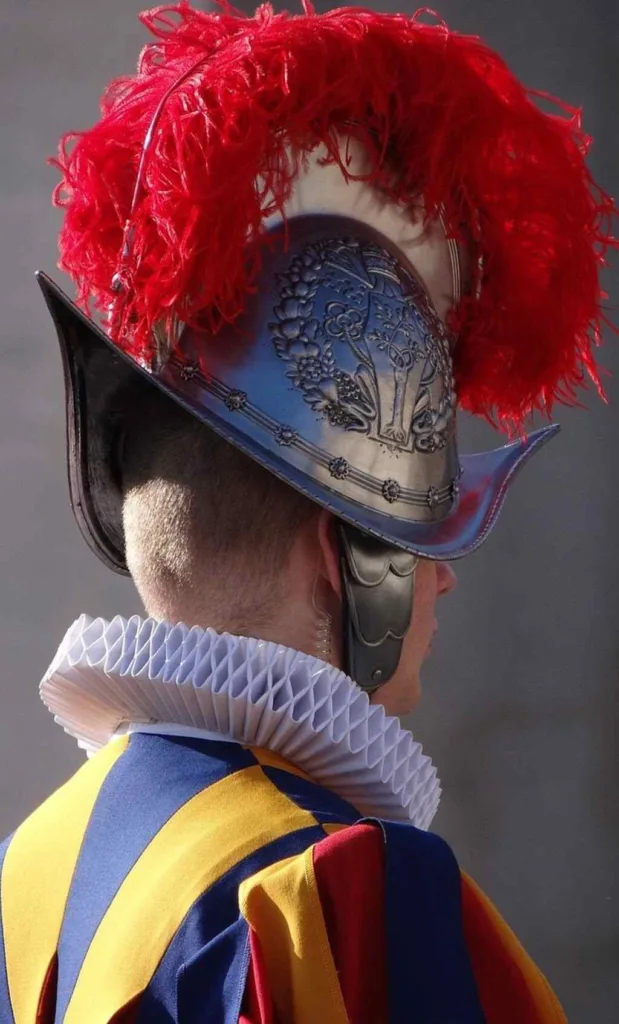
The Swiss Guards wear the morion helmet with dyed ostrich feathers, displaying the family sigil of Pope Julius II, which is represented by an oak tree. It serves as a visual representation of his authority and heritage, making it a valuable artifact in the context of Vatican history and the traditions of the Swiss Guard.
15. Since 1981, they have put more focus on their practical duties
On the 13th of May in 1981, a distressing incident unfolded in St. Peter’s Square in Vatican City. Pope John Paul II was shot and injured by Turkish assassin Mehmet Ali Ağca while he was making his way into the square.
The Pope sustained two gunshot wounds and suffered from significant blood loss. Ağca was swiftly captured and later received a life sentence from an Italian court.
Since then, the Swiss Guard has placed a stronger emphasis on their non-ceremonial roles and become more focused on ensuring the safety of the Pope.
16. Their shortest contract duration is 25 months
Swiss Guards serve for at least 25 months and can renew their contract until they are 40 years old. During this period, they attend Italian lessons if they don’t already speak the language.
17. The Swiss Guard’s Honor Duty and Guard Duty

When you see a Swiss Guard standing quietly with a halberd and not engaging in conversation, he’s on Honor Duty, and it’s best not to approach him.
On the other hand, if he’s standing with folded hands and facing people, he’s on Guard Duty. In this case, feel free to ask questions or even politely request a photo.